
(5-Step Framework for Soul-Led Entrepreneurs)
I spent close to 3 years struggling to define my identity as a spiritual entrepreneur (and aspiring business owner.)
I had the vision but absolutely zero roadmap to get there.
My original mission was simple – to help people overcome their mindset blocks and limiting beliefs in order to manifest the life of their dreams.
But the market? Absolutely saturated.
What finally shifted things wasn't a new idea or a better content strategy – it was structure.
A clear identity, a defined audience, a real client journey, and systems that could actually hold what I was building.
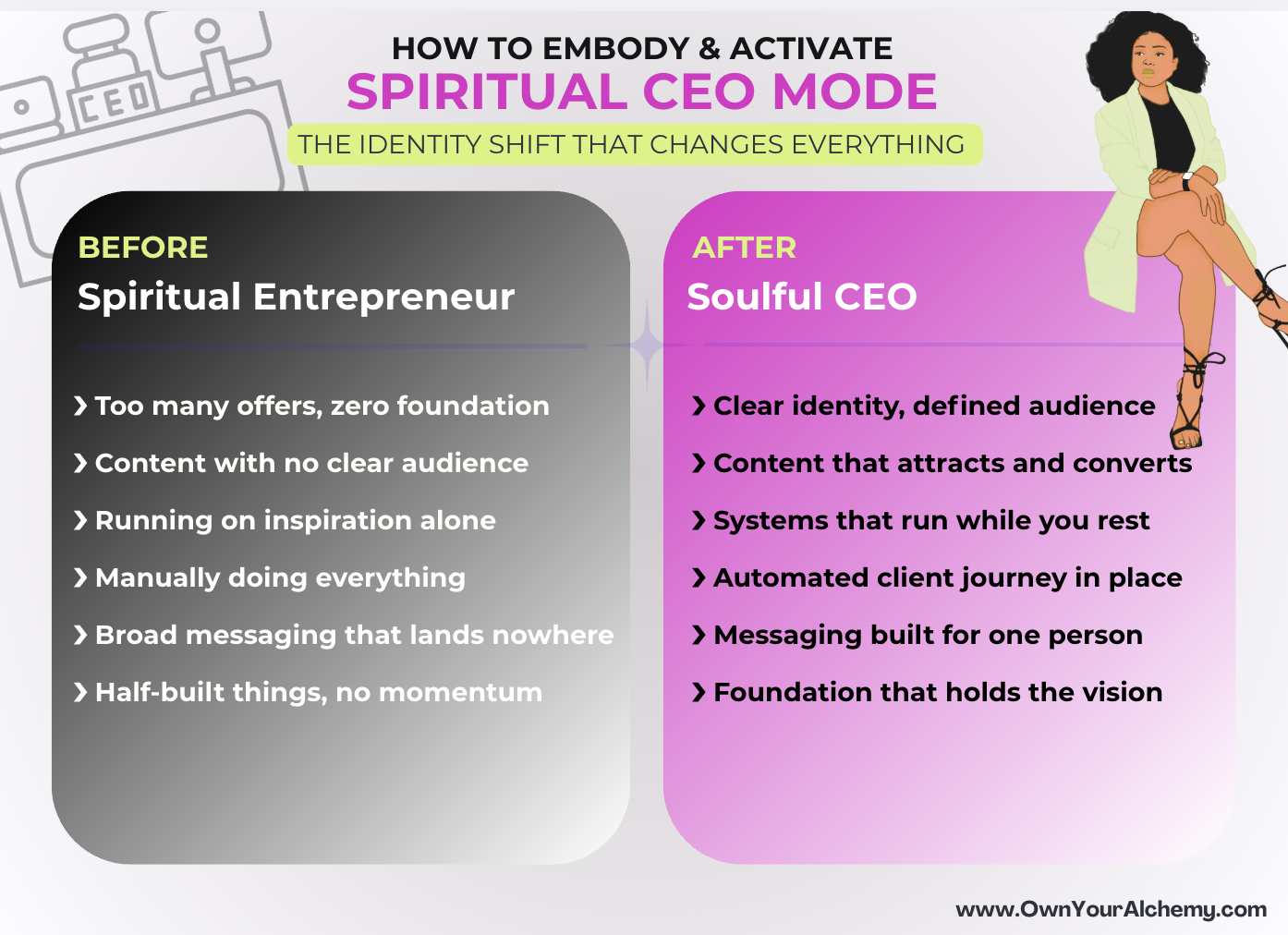
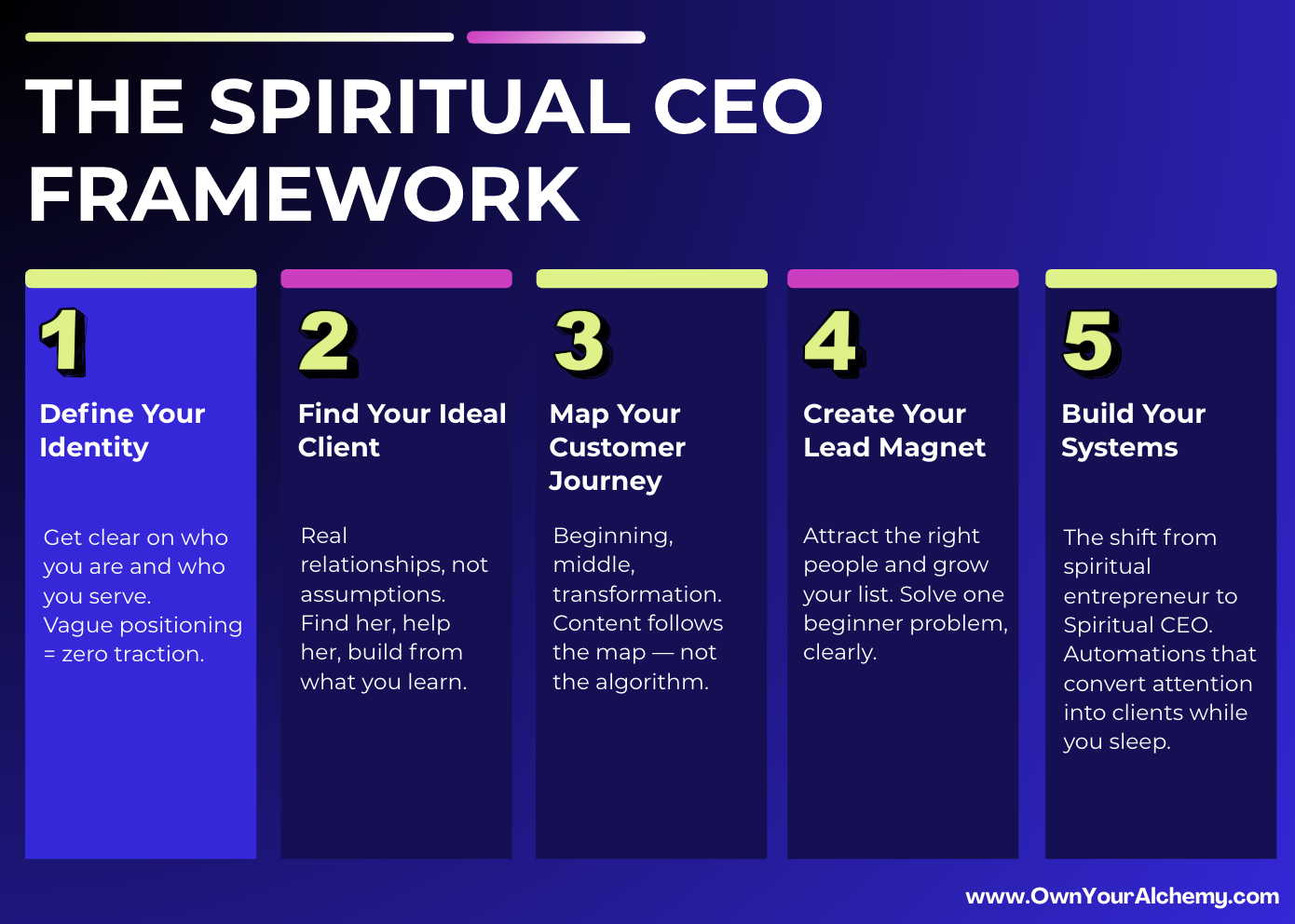
That's when everything changed — and that's exactly what I want to show you how to build. Here's the 5-step framework that helped me go from scattered spiritual entrepreneur to Spiritual CEO.
Step 1: Define who You Are & What Makes You Different
This piece of advice used to irritate TF out of me.
I hated selling myself.
I dreaded the idea of having to prove my worth in the online space. It felt outrageously overwhelming.
So, let me give you a piece of advice that I resisted for a long time. (And it may seem extremely obvious) — ask yourself , “What am I naturally good at?”
For me, that was creating systems, processes and frameworks.
I already did that for my day job as a marketer. But I heavily resisted creating my business out of it.
Why?
Because I had a vision of being a Youtube Mega Influencer.
I wanted to be IN FRONT of the screen for once, not behind it.
I wanted to create cool content and courses that people would buy every time I launched a new video.
The problem was – almost every time I published a new video, it never landed.
The views stayed stuck at around 500, my video click through rate was low, and my subscriber growth had stalled.
All because I didn’t know WHO I was in the space, or WHO I was speaking to.
My content was too broad, too vague, and lacked a real hook to pull someone in.
Here’s a real life example of who my audience was BEFORE my business identity crisis vs after.
BEFORE: I help women in their late 20’s-early 40’s, who are tired of trying manifestation tools and methods and wanted to create lasting change in their lives.
Yawn.
AFTER: I help spiritual entrepreneurs step into the role of soulful CEO of their business by defining their brand identity, creating offers that speak to their target audience, and construct automated systems so they can make money while they sleep.
Which one would you choose?
THAT’S the importance of having a clear identity.
Because it trickles down into every other area of your business.
If you need help defining your target customer be sure to read :How to Find Your Niche as a Spiritual Entrepreneur.
Step 2: Find Your Ideal Client in Real Life
Another problem I had early on?
I didn’t actually know anyone who represented my ideal client. My audience idea was too vague.
After I helped a friend solve a realbusiness problem in real time – that’s when the target customer concept clicked for me.
From then on, every piece of content I wrote, every offer I made – I made it for her.
What would she think of this offer?
Does this help her solve a real problem?
Would this type of messaging intrigue or inspire her?
If she was dealing with these challenges, that means other people were too.
I would encourage you – if you look around and don’t have an ideal customer in your immediate vicinity, go find one.
Join networking events or meetup groups … and then… help them FOR FREE.
Yes, you heard me – for FREE.
Why?
Because the insight you will gain during the process is worth way more than money in the beginning.
You’ll learn what type of intake process you need for new clients.
You’ll discover what time boundaries you need to place around your work.
You’ll figure out how you want to charge for your services – is it time based, project based, retainer fee, subscription etc.
And, it will give you confidence for when the next customer comes along.
Once you get this part locked in, you’ll know EXACTLY who you’re speaking to and how to reach them.
Step 3: Map Your Customer Journey
One of the biggest mistakes new spiritual entrepreneurs make is creating content without understanding the journey their audience is actually on.
Here’s a piece of advice that helped me immensely:
“Identify the challenges your client faces at every stage of their evolution — the beginning, the messy middle, and the transformation they’re working toward.Then, create content and offers that guide them through each phase.”
Here’s an example of my personal client’s journey:
Beginning Phase
Problem:
Inconsistent content and no recognizable brand identity.
Solution:
Defining brand colors, fonts, and messaging so their brand becomes memorable.
Middle Phase
Problem:
Unclear offers that generate occasional sales but no long-term client journey.
Solution:
Designing an offer ecosystem that guides clients from entry-level content to deeper work.
Advanced Phase
Problem:
Messy backend systems that cause lost leads and low retention.
Solution:
Conducting a business audit to simplify and streamline software tools.
Once you map these phases, your content becomes dramatically easier to create.
Video ideas might include:
How to Define Your Spiritual Business Niche
Build a Client Journey That Converts
Systems Every Spiritual Entrepreneur Needs
Now, your content starts to become a roadmap instead of random inspiration.
Once your audience journey is mapped, the next step is building an offer ecosystem that guides them through each stage. I help entrepreneurs design these inside my Digital Ecosystems consulting services.
Step 4: Craft a Lead magnet that Demonstrates Your Expertise
If you’re not familiar with a lead magnet, it’s a free piece of content that positions you as a subject matter expert and helps you attract the right audience.
When someone downloads your lead magnet, they join your email list and enter your client ecosystem.
A good lead magnet does two things:
1. Clearly identifies your audience
2. Solves a specific beginner problem
For example:
My lead magnet is called The Spiritual CEO Starter Kit.
From the title alone, you can tell:
Who it’s for → spiritual entrepreneurs
What it helps them do → turn their mission into a magnetic brand
That level of clarity matters.
But how do you figure out what your lead magnet should be?
How much value should it provide?
And how long should it be?
Let’s get into it…
What Should Your Lead Magnet Be About?
Start by writing down:
10 problems your ideal client struggles with
10 solutions you can help them implement
Then, choose the problem that has the broadest appeal and the one you can provide the most value around.
When it comes time to name it, add your target audience directly into the title.
For example, imagine you run a health and wellness business for new moms.
Your lead magnet could be called:
“The Top 5 Vitamins New Moms Need to Balance Their Energy Levels.”
From that title alone we know:
WHO it’s for: New Moms
WHAT it helps them do: Balance their energy using five simple vitamins
That’s the formula. Simple and clear.
How Much Value Should Your Lead Magnet Provide?
Think of your lead magnet as the tip of the iceberg.
When you list your 10 problems and 10 solutions, organize them by stage of the customer journey.
Beginning phase
Middle phase
Advanced phase
Your lead magnet should solve a beginner-stage problem.
This gives you more runway to guide your audience through the middle and advanced phases later on.
As you do this, you continue reinforcing your position as the expert who can guide them through the entire transformation.
How Long Should Your Lead Magnet Be?
Not to sound cliché, but it varies.
Some creators offer:
• a checklist
• a short guide
• a challenge (like a 5–7 day program)
• a diagnostic quiz
For example, in my case, I have people run a quick diagnostic on their business.
Whatever format you choose, your lead magnet should includesome kind of call-to-action or buy-in from the reader.
People are far more likely to follow through when they are participating, not just passively consuming information.
That said… keep it simple.
Don’t ask someone to build a 90-day business plan.
People get overwhelmed.
They get busy.
They abandon complicated exercises.
Your lead magnet should take no more than 5 minutes to complete or run for no longer than about 7 days.
At most, this might look like:
A 5-minute action step each day for 7 days.
Also keep in mind:
The longer your lead magnet runs, the more email reminders you’ll need to send.
If you want daily action, you’ll need daily encouragement as well.
Step 5: Build Behind-The-Scene Systems like a Spiritual CEO
This is the last step most spiritual entrepreneurs accidentally miss.
They focus on inspiration.
They focus on content.
They focus on visibility.
But they never build the systems that convert attention into clients.
Without systems, running a business becomes exhausting.
You constantly find yourself answering the same questions, repeating your offers, and manually onboarding clients.
Your mission starts to feel heavy – like you're doing a ton of work with very little momentum.
This is where the final shift from Spiritual Entrepreneur to Soulful CEO happens.
A CEO understands that inspiration alone isn't enough.
You also need:
• a clear offer ecosystem
• a lead magnet that attracts the right audience
• an email system that nurtures potential clients
• simple backend tools that keep everything organized
These systems allow your business to work for you instead of relying entirely on you.
If your backend systems feel scattered or overwhelming, I help spiritual entrepreneurs build automated business infrastructure that turns content into clients.
And when those systems are in place, something powerful happens.
You stop feeling like you're constantly chasing the next opportunity.
Instead, your business begins to feel stable, intentional, and scalable.
That’s when you move from hoping your business works… to leading it like a CEO.