
Finding your niche as a spiritual entrepreneur is a lot like trying to figure out what clique to join in high school.
And trying to choose one? Can prove to be even more daunting.
Choose wrong, and you'll be shunned and left out in the cold. (Aka your message won't land and your engagement will be low — or non-existent.)
You'll have end up wasting time building content that spoke to no one.
As someone who made a hard pivot in their target audience, think this part through carefully.
(If you’re feeling a little lost, make sure you grab the Spiritual CEO Starter Kit first — it'll show you exactly what's missing.)
Not to sound dramatic, but your niche really matters.
(P.S. If you count how many times I say "niche" in this article and message me with the correct answer, I'll give you a FREE 30-minute branding consult.
Your core messaging and the pain points you address MUST speak directly to your target group of people.
If your customer base changes, so does everything else.
Your messaging changes, your branding needs to be updated— the list goes on.
However, there are some questions you can ask yourself to make sure you're reaching the right group of people the first time around.
Let's get into it.

Step 1: Identify Your Ideal Client Avatar
People often say "your ideal audience is you, five years ago" — and honestly? There's a lot of truth to that.
Chances are, you created your spiritual business because of something you directly struggled with and overcame. This business is one of the ways you healed yourself, and now you want to help others do the same.
Does that ring a bell?
Start there.
ASK YOURSELF:
- Who was I before this transformation? What was I searching for, struggling with, afraid of?
- What did I desperately wish someone had told me when I was in the thick of it?
- Who are the people I feel most called to serve? Not who you think you should serve — who genuinely lights you up?
Your ideal client isn't a demographic checkbox. They're a person with a specific problem and a burning desire for change.
The more clearly you can picture them — their fears, their Google searches at 2 a.m., their journal entries — the more magnetic your messaging becomes.
This is the difference between a niche like "spiritual women" (too broad) and "ambitious women in their 30s who are burned out from hustle culture and craving a slower, soul-led approach to success" (now we're talking).
Step 2: Validate Your Niche Before You Go All In
Most spiritual entrepreneurs completely skip this crucial step (*ahem* myself included!)
They assume they know what their audience wants instead of actually asking.
Validation doesn't have to be fancy. It can look like:
Hopping into Facebook groups or Reddit threads where your ideal clients hang out and reading what they're actually complaining about
Sending a quick DM survey to your existing followers asking what their biggest struggles are
Offering a free 30-minute discovery callto a handful of potential clients and listening more than you talk
Checking keyword search volume for terms related to your niche (tools like Ubersuggest or Google's free Keyword Planner can show you how many people are searching for what you offer)
That last one matters for SEO.
If no one is searching for "human design career coaching for empaths," you might love the concept — but the market might not be loud about it online yet.
Validate that there's an audience and that they're actively seeking help.
If people are already asking the questions you know how to answer? That's your green light.
Not sure how to make your spiritual values work with your business strategy? This might help.
Step 3: Common Niche Mistakes Spiritual Entrepreneurs Make
Let's save you some time (and tears) by running through the biggest pitfalls:
Mistake #1: Going too broad
Let me give you an example. When I was first starting out, this is what I wrote for my target audience.
BEFORE: “I help women in their late 20’s-early 40’s, who are tired of trying manifestation tools and methods and wanted to create lasting change in their lives.”
Yawn.
AFTER: “I help spiritual entrepreneurs step into the role of soulful CEO of their business by defining their brand identity, creating offers that speak to their target audience, and construct automated systems so they can make money while they sleep.”
Which one would you choose?
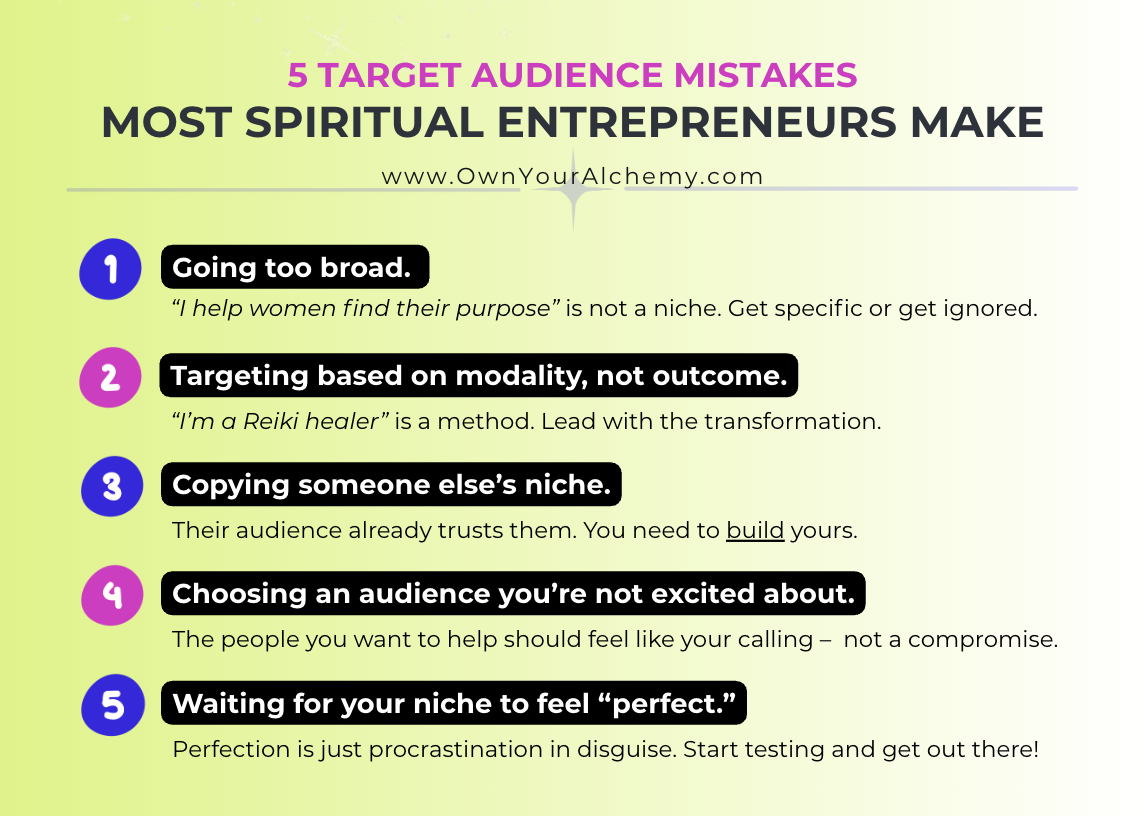
Mistake #2: Niching based on your modality instead of your client's outcome
"I'm a Reiki healer" is a method, not a niche. Your clients don't care as much about how you help them as they do about what changes in their life as a result. Lead with the transformation.
In this example as a Reiki Healer your niche could be “women 30+ with an inner child wound that keeps attracting unstable relationships”.
The transformation would be — “ I help women 30+ heal their inner child wound so they can finally attract the partner they’ve been subconsciously pushing away.”
Damn, that hits! Doesn’t it?
That’s the power of a strong audience segment.
Mistake #3: Copying someone else's niche because it looks like it's working for them
Their audience trusts them. You need to build an audience that trusts you — and that starts with authentic positioning, not imitation.
This is also why cookie-cutter spiritual marketing doesn’t work – here’s what to watch out for instead.
What’s your secret sauce?
What’s a transformation or an irresistible offer that NO ONE else could create or image – but you.
Do you have unique background experience or certifications?
Did you study under someone very well-respected in your field?
Highlight your area of expertise.
For me, it’s 10+ years of marketing experience and building my own personal brand from the ground up.
Mistake #4: Choosing a niche you're not actually excited about
Spiritual entrepreneurship is a long game. If you're not genuinely passionate about your niche, it will show — and burnout will come fast. Your niche should feel like a calling, not a compromise.
If you’re a multi-passionate entrepreneur, it can be tempting to go with whatever channel is bringing in the most revenue But if you’re not in love with the audience you’re attracting — is it really worth it?
A business coach I once heard said: “If you’re not passionate about solving the problems you’re speaking about, don’t post them to begin with.”
Period.
Mistake #5: Waiting until your niche is "perfect" to start
Perfection is just procrastination in a trench coat. Start with your best guess, create content, talk to people, and let the niche refine itself over time.
And by any means necessary – track your performance.
What content got the most views, the most engagement, generated the most questions?
Think about what problem that piece of content solved and WHO would be looking for it?
But most importantly, ask yourself “is this a topic I want to keep talking about?”
Step 4: How to Pivot If You Chose the Wrong Niche
First: take a deep breath. This happens more than you think, and it's not the end of the world.
A niche pivot doesn't mean you've failed — it means you've learned. Here's how to do it without burning everything to the ground:
If you're navigating a pivot and need support, working with a spiritual business coach can help you move faster and with a lot less second-guessing.
1. Don't ghost your current audience.
Give them a heads-up. You don't have to write a dramatic "I'm changing everything" post, but a transparent, heartfelt message about your evolution goes a long way. People respect realness.
2. Identify what's carrying over.
Your skills, your values, your personal story — those don't disappear. What shifts is who you're speaking to and the specific problem you're solving. Take inventory of what transfers.
3. Update your content gradually.
You don't need to delete everything and start over. Begin creating content aimed at your new ideal client and let the old stuff phase out naturally. Your new audience will find you through the new content.
4. Revisit your offers, messaging, and bio.
Your Instagram bio, website headline, and core offers are the first things to update. These are the places where people decide in seconds whether you're for them.
5. Give yourself a timeline.
A pivot takes time to gain traction — usually three to six months before you start seeing meaningful results. Trust the process (you know, the thing you probably tell your clients).
The Bottom Line on Finding Your Spiritual Entrepreneur Niche
Your niche isn't a cage — it's a compass.
It points you (and your ideal clients) in the right direction. It makes your marketing easier, your content clearer, and your offers more irresistible.
Yes, choosing a niche feels scary. Yes, it requires you to say no to some people so you can say a resounding yes to others.
But the spiritual entrepreneurs who thrive are the ones who get specific, stay consistent, and trust that there are more than enough people out there who need exactly what they offer.
Now go find your people.
---
Did this resonate? Save this post for when you're second-guessing your niche at 11pm (we've all been there). And don't forget — count the number of times I said "niche" and message me for your free 30-minute branding consult.